 images/bannerimages/Blog-Banner.jpg

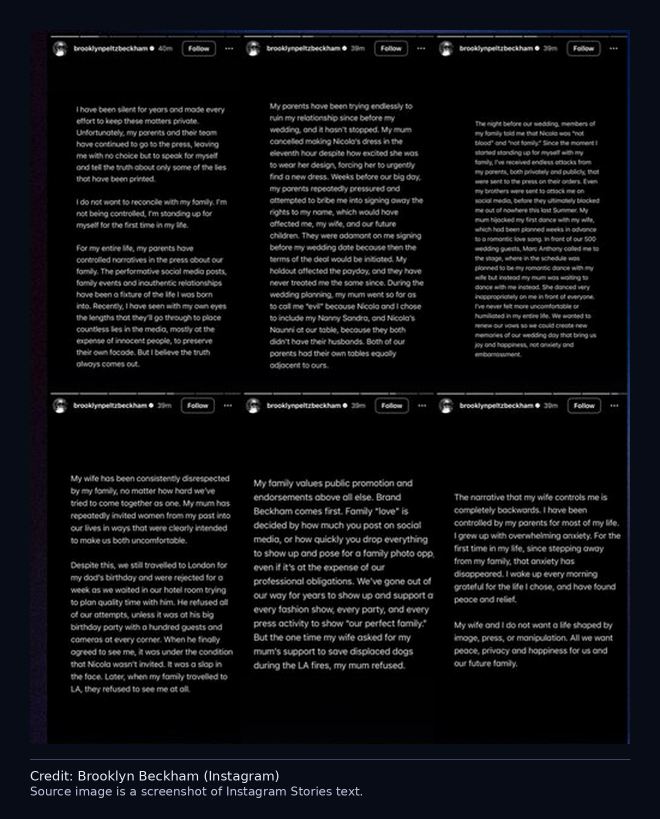
This is what “versions of events” looks like in the modern celebrity economy: a public-facing rewrite of private life that presents motive, assigns intent and lands as moral certainty. It is not unique to the Beckhams. We have seen a similar approach in other high-profile family ruptures, where each side frames the same moment as either loving inclusion or calculated humiliation, either boundary-setting or coercion, either a misunderstanding or a campaign. The method works because it harnesses ambiguity.
Take something as plain as an invitation to a party.
- Version 1: a happy invite, normal family behaviour
- Version 2: pressure, because “no” will be punished later
- Version 3: intimidation, because the inviter has status and influence
- Version 4: obligation, because the inviter funds the machine around you
- Version 5: control, because the invitation is really a loyalty test
None of these versions can be disproven in public, because they are about how something felt. That is why this style of post is so potent, and so corrosive. It moves the debate away from verifiable facts and into interpretations of intent.
Brooklyn’s posts, as reported by multiple outlets, allege long-running manipulation, media briefing and specific wedding-related grievances including a dispute over Nicola Peltz Beckham’s dress and a moment at the reception involving a “first dance.” Those claims have drawn headlines precisely because they reframe familiar tabloid folklore into an authored narrative, and because they position “Brand Beckham” as both weapon and asset.
That is the part that lands poorly for many observers. When your career has benefited from access, association and the halo of a global family brand, a public detonation reads less like bravery and more like a tantrum when the terms of the relationship change. It can come across as entitlement, even if pain is real.
You called out the sharpest strategic point: if he uses the Beckham name while denouncing what that machinery represents, he is implicitly conceding the value of the very PR ecosystem he is attacking. That contradiction becomes the story.
If you were David and Victoria Beckham’s crisis team, what would you do?
This is a family crisis, a corporate crisis and a brand architecture problem at the same time. The objective is not to “win” the argument. The objective is to protect the Beckham enterprise, reassure commercial partners and prevent a rolling cycle of retaliation content.
1) Establish the red lines in the first 2 hours
Do not litigate point-by-point on social. It invites a sequel and turns the brand into a reality series.
- No subtweets, no “cryptic” captions
- No proxy commentary from friends, stylists, former colleagues
- No family members liking, commenting or “clarifying” via side accounts
This is basic crisis hygiene. The fastest way to extend the crisis is to create more surfaces for journalists to quote.
2) Build a single holding statement that is human, not legal
A holding statement buys time, sets tone and signals boundaries. Crisis playbooks consistently recommend prepared templates and controlled messaging rather than reactive debate.
What it needs to do:
- Acknowledge pain without validating allegations
- Signal willingness to resolve privately
- Protect minors and private individuals
- Confirm no further comment for now
What it must avoid:
- “We deny” language that sounds combative
- Any reference to Nicola as the “cause”
- Any hint of disinheritance, money, leverage
3) Separate “family” from “enterprise” in the operating model
Brand Beckham is an ecosystem: endorsements, fashion, sport, licensing, production, media. The family story fuels it, but it cannot be held hostage by it.
Create a temporary firewall:
- A dedicated comms lead for enterprise stakeholders (brands, agents, partners)
- A separate confidential channel for family resolution (lawyers and mediator)
- No overlap of messaging or decision rights
4) Make one private move that can later be inferred publicly
You cannot prove love in a statement. You prove it in behaviour. The best crisis work creates a “credible path back” without grandstanding.
Examples:
- Offer professional mediation, with confidentiality terms
- Offer a private meeting that includes a neutral third party
- Offer a written commitment to stop briefing, on both sides
If it is rejected, you do not leak that it was rejected. You keep the record for protection and pattern management.
5) Protect commercial partners with proactive outreach
You do not wait for brand partners to call you.
- Call top-tier partners within 24 hours
- Provide a calm, consistent line: “private family matter, we are handling it responsibly”
- Offer monitoring updates and a point of contact
This is about reducing perceived risk. Crisis best practice is stakeholder-specific communication, not blanket broadcasting.
6) Audit the narrative supply chain and shut off “helpful” leaks
You asked where stories may be planted. In celebrity crises, narrative often travels through:
- Friendly columnists and entertainment desks
- “Close to the family” sourcing that is technically deniable
- Brand-adjacent insiders who think they are protecting reputation
- The social graph, likes, follows, exclusions from events
Your job is to stop amateur hour. If anyone around the Beckhams is briefing, even with good intentions, it keeps the scandal liquid.
Action:
- A written instruction to all reps, staff, extended team: no off-the-record commentary
- A single authorised spokesperson, if needed
- Centralise approvals for any public-facing content
7) Avoid the trap of disproving feelings
This is crucial. Brooklyn’s statements are framed around lived experience. You cannot “fact-check” humiliation without looking cruel.
Instead, reposition the brand around values that are hard to argue with:
- Family privacy
- Mental health and wellbeing
- Dignity in disagreement
- Commitment to resolve privately
8) Choose one of three strategy paths, then commit
Pick the path that fits the Beckham brand equity and risk tolerance.
Path A: Strategic silence private resolution
Best when you want the story to starve. Most effective if there is no ongoing drip of counterclaims.
Path B: Short statement mediation posture
Best balance of humanity and control. Minimises reputational damage without escalating.
Path C: Controlled long-form, later
Only if the crisis keeps reigniting. A single serious interview, tightly prepared, focused on principles not details. No scorched earth.
9) Rebuild by shifting attention to anchored assets
The Beckham brand is at its strongest when it is about craft, discipline and philanthropy, not family theatre.
You do not distract. You re-anchor:
- Victoria’s business work, product, design integrity
- David’s leadership platform and community credibility
- Foundation initiatives, measurable outcomes
This is not optics. It is brand restoration through substance.
10) Manage Brooklyn as a sub-brand, even if he is family
This is the hard truth: Brooklyn is now a reputational variable.
If he continues to monetise the Beckham name while attacking the family machine, it will create a partner dilemma. Some brands will stay, some will pause. The enterprise response should be:
- Clarify trademark and licensing governance privately
- Stop informal “brand borrowing” arrangements
- Ensure any future usage is contractual, explicit and defensible
This prevents the scenario where he benefits commercially from the brand while actively degrading it.
What happens next, and how you prevent a second wave
Second waves come from three places: reaction posts, “exclusive sources” and opportunistic tabloids repackaging old claims. The reporting already shows the story is moving quickly and will attract iterative coverage.
Your prevention plan:
- 24/7 monitoring for 72 hours
- Pre-drafted Q&A for partners and media
- A decision rule: do not respond unless there is new verified information that changes stakeholder risk
- A quiet off-ramp: mediation offer remains open, no public bargaining
PR is a dangerous game when you release it in the heat of the moment on social media. Is Brooklyn Beckham playing Harry's game and is he being pushed along like a puppet who is feeling quite powerful with his 16.1 million followers on Instagram - which he wouldn't have if it wasn't for the Beckham name.
People love to take a side - but unfortunately, this ideation of "they have been controlling me my whole life" is probably not going to fall the way the young Beckham would have hoped.