 images/bannerimages/Blog-Banner.jpg

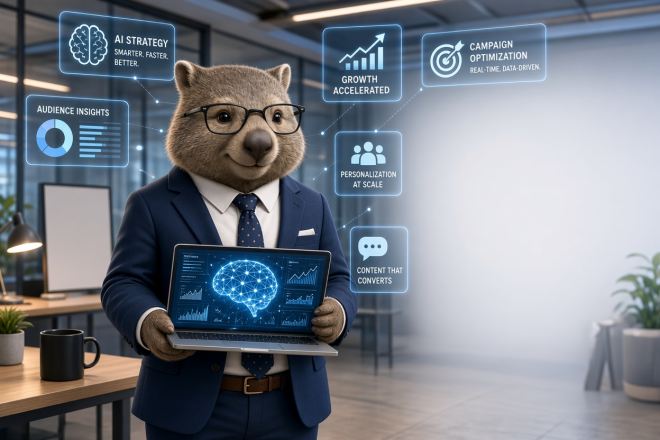
For business leaders, the question is no longer, “Do we need a marketing agency?” The more important question is, “What kind of marketing partner do we need to compete in an AI-driven market?”
The answer depends on whether an agency can help the business build a modern marketing system rather than just deliver isolated campaigns.
The Traditional Marketing Agency Model Is Under Pressure
Traditional marketing agencies were built around specialist services. A business might hire one agency for branding, another for website design, another for paid advertising, and another for public relations or social media. Each provider could be capable, but the overall customer experience and commercial strategy often became fragmented.
This model can create familiar problems. Marketing activity is difficult to connect to revenue. Content is created without a clear distribution or conversion strategy. Paid advertising generates leads that sales teams do not consider qualified. Reporting focuses on impressions, clicks, and engagement rather than commercial outcomes. Campaigns take weeks or months to produce, even when market conditions are changing daily.
AI marketing tools have raised expectations. Businesses can now generate first drafts of content, analyse campaign performance, identify audience patterns, personalise communications, create image variations, automate reporting, and test creative concepts far more quickly than before. This does not mean artificial intelligence can replace marketing strategy, customer understanding, creative judgement, or brand leadership. It does mean that agencies relying on slow, manual, disconnected processes are becoming less competitive.
The businesses that benefit most from AI are not those producing the largest volume of content. They are the ones using technology to improve decision-making, reduce unnecessary work, and create more relevant customer experiences.
Marketing Is Moving From Campaigns to Systems
A campaign has a start date, an end date, a budget, and a set of deliverables. A marketing system is different. It is an ongoing process that connects customer insight, positioning, content, media, sales enablement, data, automation, and performance measurement.
This distinction matters because customers do not experience a brand as a campaign. They experience it through a series of interactions: a Google search, LinkedIn post, website visit, email, sales conversation, product demonstration, onboarding message, customer-support interaction, or referral.
An effective AI marketing agency helps businesses manage these connected interactions. It uses data and automation to understand where prospects enter the journey, what information they need, what stops them from converting, and how to continue the relationship after a sale.
For example, instead of publishing generic blog content every week, a growth-focused agency may identify the questions buyers ask at each stage of the decision process. It can then create search-optimised articles for awareness, comparison pages for consideration, case studies for evaluation, and automated email sequences that support prospects after they download a resource or request a consultation.
The result is not simply more marketing activity. It is a clearer pathway from attention to trust, conversion, retention, and advocacy.
AI Does Not Replace Strategy
One of the most common misconceptions about AI marketing is that it makes strategy unnecessary. In reality, AI makes strategy more important.
AI tools can generate copy, images, summaries, audience segments, reporting insights, and campaign variations. However, a tool cannot independently determine what a business should stand for, which market segment it should prioritise, how it should differentiate from competitors, what commercial trade-offs are sensible, or what message will build long-term trust.
Without a clear strategy, AI can accelerate the production of average marketing. It can create more posts, more ads, more emails, and more reports without solving the underlying problem of weak positioning or unclear customer value.
- A strong marketing agency begins with the fundamentals: Who is the priority customer? What business problem does the brand solve? Why should customers choose this business over alternatives? What proof supports the value proposition? Which channels influence buying decisions? What action should customers take next? How will marketing contribution be measured?
Once these questions are clear, AI can be used to make execution more efficient and responsive. The technology should support the strategy, not substitute for it.
What an AI-Powered Marketing Agency Should Deliver
Businesses should expect more from marketing agency services than content production or advertising management. A modern agency should help create an integrated growth capability that becomes more effective over time.
First, it should provide customer and market intelligence. This includes analysing audience needs, search behaviour, competitors, reviews, sales conversations, CRM data, and campaign results. The agency should turn fragmented information into practical insight about what customers care about and where the business can win.
Second, it should develop a clear marketing strategy. That strategy should connect brand positioning, demand generation, content, SEO, paid media, customer journey design, marketing automation, and sales enablement. It should explain not only what will be done, but why it matters and how success will be measured.
Third, it should build reusable marketing assets and workflows. Instead of creating every campaign from scratch, an AI marketing agency can develop message frameworks, content pillars, audience segments, prompt libraries, approval processes, reporting dashboards, email sequences, and creative templates. These assets reduce cost, improve consistency, and make future work faster.
Fourth, it should create a measurement system that connects activity with business outcomes. Views, impressions, clicks, and followers can be useful indicators, but they are not the final objective. Better measures include qualified leads, conversion rates, cost per opportunity, sales velocity, customer acquisition cost, retention, expansion revenue, and lifetime value.
Finally, the agency should help internal teams become more capable. The best outsourced marketing team does not create dependency. It transfers knowledge, documents processes, improves governance, and gives internal stakeholders greater visibility and confidence.
The New Agency-Client Relationship
The relationship between a business and its marketing agency should be more collaborative than transactional. When an agency only receives a list of deliverables, it can only optimise the work requested. When it understands the business model, customer journey, sales process, product roadmap, and commercial priorities, it can identify opportunities that the client may not see internally.
This requires transparency on both sides. Businesses should share relevant sales data, customer feedback, market changes, customer objections, and product updates. Agencies should share performance data, testing results, strategic reasoning, assumptions, and recommendations.
A useful way to think about an agency is as an extension of the marketing team. It should bring external perspective, specialist expertise, flexible capacity, and proven methods. At the same time, it should work closely enough with internal decision-makers to understand the brand, customer, and commercial context.
The strongest partnerships are built around shared outcomes rather than output alone. Instead of measuring an agency solely by the number of articles, ads, or social posts delivered, assess whether it is helping improve pipeline quality, visibility in search, conversion efficiency, customer engagement, and revenue growth.
Why This Topic Has Share Potential
The question of whether AI will replace marketing agencies is naturally shareable because it speaks to a genuine business concern. Founders worry about agency costs. Marketing leaders worry about doing more with limited budgets. Agency owners worry about differentiation. Internal teams worry about whether AI will remove roles or change expectations.
The more useful and credible angle is not that “AI will replace agencies.” It is that AI is changing what businesses should demand from agencies.
That framing encourages discussion because it is practical rather than sensational. It challenges both sides of the agency-client relationship. It also gives readers a clear takeaway: the future belongs to agencies that combine strategic expertise, customer understanding, technology, creative judgement, and accountable execution.
A strong LinkedIn headline for promoting this article could be: “AI will not eliminate marketing agencies. It will expose the agencies that only sell hours and deliverables.”
How to Choose a Modern Marketing Agency
When evaluating a digital marketing agency, look beyond its service list. Ask how it approaches customer insight, positioning, data, AI, automation, reporting, and collaboration with internal teams.
Useful questions include: How do you connect SEO, content, paid media, CRM, and sales activity? How do you use AI marketing tools while protecting brand quality and accuracy? What customer and market research informs your recommendations? Which metrics do you use to measure commercial impact?How will you improve our internal marketing capability? What workflows, assets, and data will remain with our business? How do you test ideas and decide what to scale? What would you stop doing if the data showed it was ineffective?
The goal is not to hire the agency that promises the most activity. It is to choose the partner that can create the greatest clarity, momentum, and measurable impact. One that can truly work with AI but give you the creativity and personalized approach you deserve.